
For landlords in England who manage their own lets
When you need your property back, the paperwork has to be right.
Since 1 May 2026 there is no Section 21. Every possession claim goes to court, and a judge cannot make an order if your tenant’s deposit paperwork was never done. ServeProof prepares the documents the law says your tenant must have, sends them, and keeps a dated record of exactly what went to whom.
Free for your first property. No card needed. England only.
Tenancy file
14 Bramhall Lane, Stockport
-
Deposit protectedDPS · ref 1284-5530-7716 · 3 June 2026
If you took a deposit, a court can only order possession once it is in an approved scheme, whichever ground you use, apart from the anti-social behaviour and nuisance grounds (7A and 14).s.215 Housing Act 2004, as amended by the Renters’ Rights Act 2025
-
Deposit prescribed informationEmailed to both tenants · 3 June 2026, 17:41
The same bar applies until the prescribed information has been given, with every particular the 2007 Order lists and your signed certificate. Getting it wrong also exposes you to a claim of one to three times the deposit.ss.213–215 Housing Act 2004; SI 2007/797
-
Written Statement of TermsEmailed 2 June 2026, four days before move-in
Due before the tenancy is agreed. Miss it and the council can fine you up to £7,000, and relying on several possession grounds without it is a further breach it can fine you for.ss.16D, 16E(1)(f) and 16I Housing Act 1988
-
Gas safety recordCopy served 5 June 2026 · renew by 28 May 2027
A Gas Safe check every 12 months, with a copy to the tenant within 28 days and before a new tenant moves in.reg. 36 Gas Safety (Installation and Use) Regulations 1998
-
Electrical report (EICR)Copy served 5 June 2026 · next due February 2030
An inspection at least every five years, with a copy to the tenant. Councils can fine up to £30,000.Electrical Safety Standards in the Private Rented Sector (England) Regulations 2020
-
Energy certificate (EPC)Rating C · copy served 5 June 2026
A property must be rated E or better to be let, and the tenant must be given a copy.Energy Efficiency (Private Rented Property) (England and Wales) Regulations 2015
-
Next rent reviewEarliest rise 6 June 2027 · serve Form 4A by 5 April 2027
Rent can rise once every 52 weeks, never in the first year, and only by Form 4A with at least two months’ notice. A rent-review clause in the agreement no longer works.s.13 Housing Act 1988, as amended
 Paperwork in order. If you ever need to serve notice, this file goes in the bundle.
The law now
What changed on 1 May 2026
The Renters’ Rights Act rewrote the rules for every private tenancy in England. Four changes matter most for your paperwork.
-
Section 21 has gone
To get a property back you now serve a Section 8 notice on Form 3A, rely on a ground, and, if the tenant stays, go to court. Every tenancy is periodic; fixed terms no longer exist. Work out your earliest court date.
Renters’ Rights Act 2025; Housing Act 1988 Sch. 2
-
No deposit paperwork, no possession order
If you took a deposit, the court can only order possession once it is protected and the prescribed information has been given. It doesn’t matter which ground you rely on, unless it’s one of the anti-social behaviour and nuisance grounds (7A and 14).
s.215 Housing Act 2004, as amended
-
A Written Statement before every new tenancy
New tenancies need a Written Statement of Terms before they start. Without it the council can fine you up to £7,000, and relying on several possession grounds without it is a further breach.
ss.16D, 16E and 16I Housing Act 1988
-
Rent goes up once a year, on Form 4A
Two months’ notice, not in the first year, not more than once in 52 weeks, and only on the official form. An increase made any other way is void.
s.13 Housing Act 1988, as amended
What ServeProof does
What ServeProof does
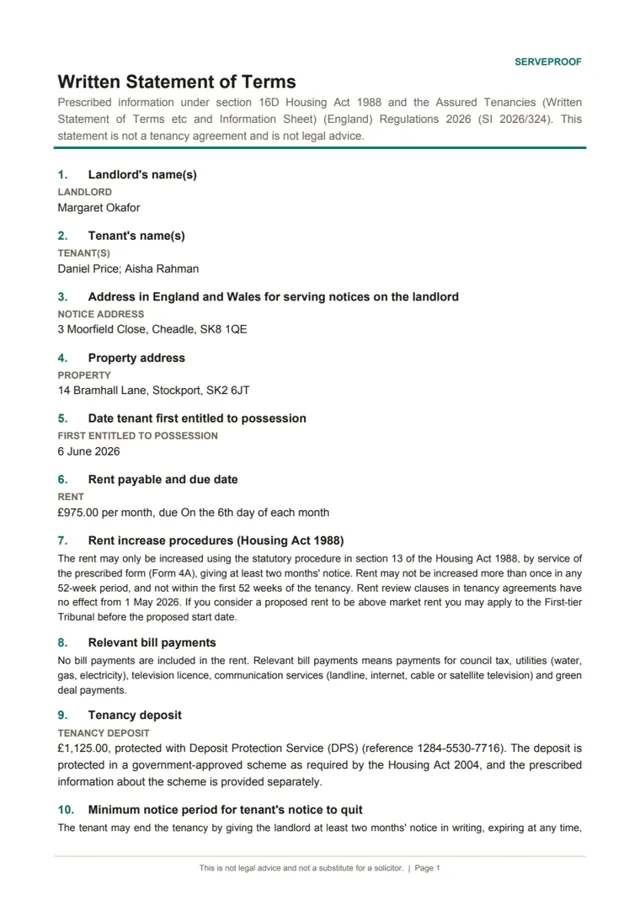
The right documents, filled in properly
You enter the tenancy once: the address, the tenants, the rent and the deposit. ServeProof prepares what the law requires for that tenancy.
- The Written Statement of Terms, covering every item on the government’s prescribed list
- The official Renters’ Rights Act Information Sheet: the exact GOV.UK file, never a copy or a link
- Deposit prescribed information with every particular the 2007 Order requires, and your signed certificate
- Section 13 rent increases on the official Form 4A, with the timing rules checked for you
- Section 8 notices seeking possession on the official Form 3A: every ground in its full legal wording, the earliest court date worked out, and the deposit and arrears bars checked before you serve
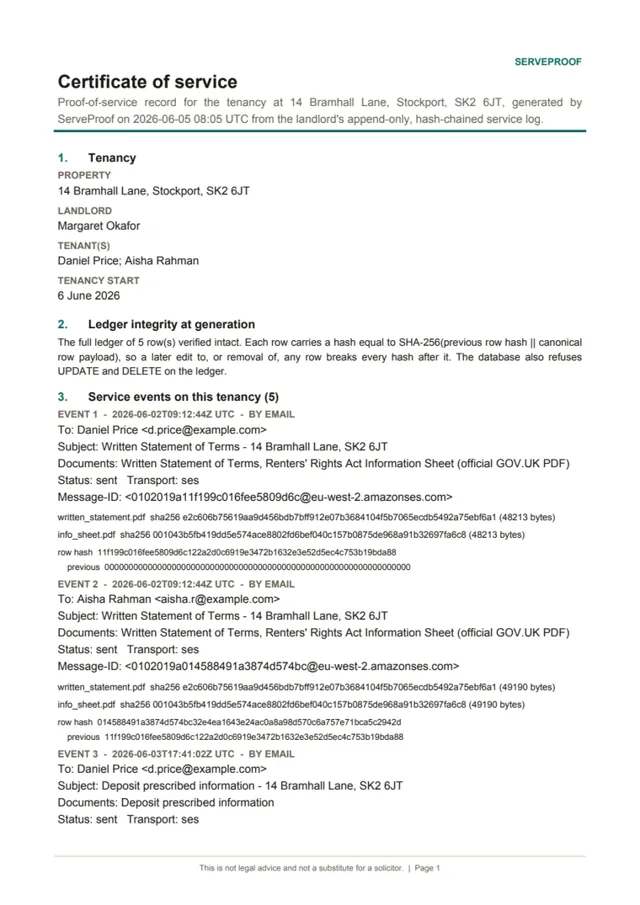
Sent to your tenant, with a record a court can read
Each tenant who has agreed to receive documents by email gets them as attachments, sent on your behalf. If you hand them over or post them, you record that instead.
- Every record says what was sent, to whom, when and how
- Each file is fingerprinted, so a changed document or a back-dated record would show
- One PDF certificate of service per tenancy, ready for a court bundle
- Anyone you give a record reference to can check it on our verify page
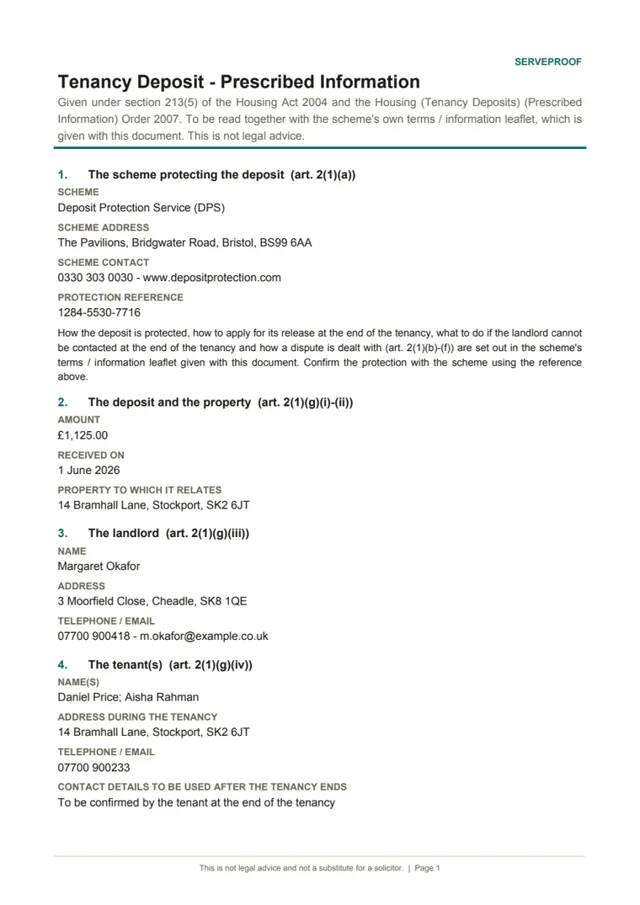
Reminded before anything lapses
Safety certificates expire and rent can only rise on a set clock. ServeProof keeps track so you don’t have to.
- Certificate reminders at 60, 30, 14, 7 and 1 days before a gas record, EICR or EPC runs out
- The rent-review clock: the earliest date a rise can take effect, and the last day to serve Form 4A for it
- A list of which tenancy is missing which document, on the first screen you see
A fair question
Can’t I just email the documents myself?
Yes. Nothing in the law says you need software, and plenty of landlords do this by hand. If you do, keep these for every tenant, for the whole tenancy and six years after it ends:
- The exact file you sent, not a later edited version.
- The email itself, showing the date, the time and the address it went to.
- The tenant’s written agreement to receive documents by email. Without it, an email may not count as proper service.
- For the deposit: the scheme certificate, and prescribed information carrying every particular in the 2007 Order, with your signed certificate.
ServeProof keeps all of that together for each tenancy and turns it into one certificate. If you’d rather do it yourself, our free guides say exactly what to keep.
What it costs
Documents are free. You pay when you send with proof.
No contract and no card to start. Full pricing and questions.
Your first property
To try it properly
Every document, certificate reminders and the rent-review clock. Download the documents and serve them yourself.
Free
Serve Pack
One tenancy. Best if you let one property
Send with proof, record post or hand delivery, and download the certificate of service, for as long as that tenancy runs.
£29once
Landlord plan
Two to 20 properties
Everything, on every tenancy, up to 20 properties. Cancel from your billing page whenever you like.
£119a year, or £15 a month
Section 8 notice
When you need the property back
The official Form 3A filled from the tenancy, the dates worked out, every bar checked, and service recorded with proof. Try the free date calculator.
£49per notice
Questions
What landlords ask us
Is this legal advice?
No. ServeProof fills in the forms the law prescribes, sends them and keeps the record. It doesn’t tell you which possession ground to use or whether to go to court. For that, speak to a solicitor.
My tenancy started before 1 May 2026. Does any of this apply?
Yes. Existing tenancies became periodic on 1 May 2026, and tenants with a written agreement had to be given the official Information Sheet by 31 May 2026. If that was missed, give it now and keep the record. The deposit rule applies to every assured tenancy.
Does it do Section 8 notices?
Yes. ServeProof fills the official Form 3A from your tenancy with the full legal wording of each ground, works out the earliest date you can go to court, refuses to let you serve while the deposit or arrears rules would sink the claim, and records service with proof. £49 per notice. It doesn’t decide whether your ground is made out; for that, take advice. Work out your dates free.
What about the new landlord database?
Every landlord letting in England must register each property on the government’s “Register your rental property” service. It opens on 15 December 2026 in the West Midlands, and everyone must be registered by 14 November 2027. Once your region’s deadline has passed, a court can’t make a possession order on most grounds while you’re unregistered. ServeProof keeps the gas, electrical and energy certificates you’ll need, and your registration numbers, on each property. Read the guide.
What if the government changes a form?
ServeProof pins each official document to its exact file and checks GOV.UK every day. If a form changes, sending pauses until the new version has been checked, so you never send an out-of-date one.
What happens to my records if I stop paying?
They stay in your account. You can still open every document and download the certificate of service for any tenancy you have served. You just can’t send new documents with proof until you buy a Serve Pack or rejoin the plan.
Do you cover Wales, Scotland or Northern Ireland?
No. They have different laws and different forms. ServeProof is for tenancies in England only.
Who runs ServeProof?
Jadthena Limited, a company registered in England and Wales (no. 16232930). We are not a firm of solicitors. Questions go to help@serveproof.co.uk.
Start with the free check
Find out in two minutes whether your paperwork would stand up.
Answer a few questions about one tenancy. You get a list of what’s in order, what’s missing and what each gap can cost. Nothing you enter is stored.